
Spring Training Tips
Leash manners, calm behavior, and practical training insight from Ryan & Amy
From Ryan & Amy
Owners & Head Trainers
This is our first newsletter, and we want to thank you for being a part of our pack!
We appreciate you and your dog!
With the cooler spring mornings and longer days, we’ve had a full house and have been enjoying all the training, playing, and working outside.
To get your dog from point A to point B requires a leash. This wonderful tool is used to maintain position in the pack and provide structure for the activity. Dogs learn quickly when the message is clear.
A topic for today is something we feel both you and we are dealing with: leash pulling. Most dogs are very good at this, proving themselves strong and “in charge.” Why is this such an important topic?
A lot of behavior really does start on the leash. Without structure, we see pulling, lunging, barking, and overall, the dog can either constantly be on edge or relaxed, all depending on the energy they are receiving through the leash from us to the dog. They feel everything we feel, and sometimes I think my dog can read my thoughts. We can use this to our advantage!
Correct leash handling builds trust with your dog. This is a big deal to our dogs, and we need to take it seriously. Dogs are very black and white when it comes to their place in the pack. How you handle the leash lets your loved one know whether you are in charge — “ALPHA” — or simply a “LITTERMATE” (someone to pull around or ignore).

Training Insight
Structure creates clarity. Clarity builds confidence.
When your dog is on the leash, their job is to pay attention to you.
That doesn’t mean they can’t ever relax, but it does mean the walk should have structure and purpose. Without that, dogs tend to fall back on instinct and make their own decisions.
Clarity is what builds confidence.
When a dog understands what’s expected—physically and mentally—you start to see calmer behavior and better engagement.
Practical Tips
"Change Direction"
A simple reset that brings your dog’s focus back to you
This technique involves turning around when your dog starts to pull.
As soon as you feel tension in the leash or your dog begins moving out of the “heel” position, do the following:
-
Promptly turn
-
Walk in the opposite direction
-
Give the “here” command
-
Pop and release the leash
This gives the message to your dog to “pay attention” and “keep up,” reinforcing the idea that staying close and NOT pulling leads to a pleasant and predictable experience.
Keep the leash loose and relaxed. If the leash remains in full tension, so does the dog, increasing reactivity.
Take a deep breath and relax. The dog will follow suit.
Save your shoulder and practice.
A few minutes every day really does add up.
Still having trouble or want more information?


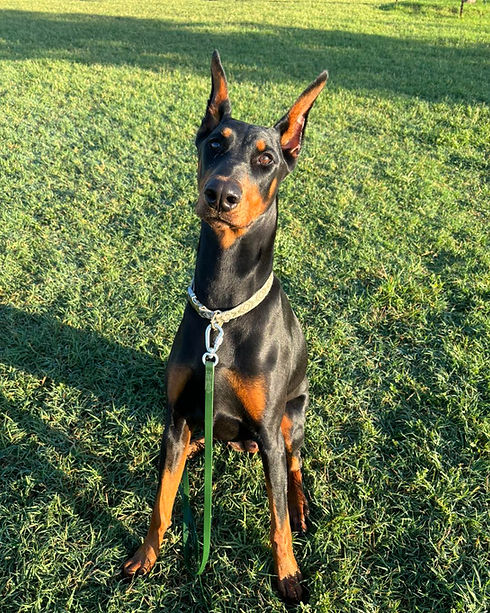
Client Spotlight- Creed
Every dog learns differently, and Creed is proof of that
Creed is an overachiever, but truly only interested in bringing me gifts and having me throw them: sticks, rocks, grass, air... lol. He is constantly on the lookout for anything retrievable.
He’s a working breed, sweet, but not overly interested in cuddling or slowing down for too long.
A lot of his training has focused on gaining his attention on something other than a possible retrieve. He works hard and has been learning how to kennel, heel, return to handler, and, surprisingly, “sit.” That has probably been the most challenging command for him. He is either all go or laying down.
For dogs like Creed, especially working and herding breeds, the “down” position can come much more naturally than “sit.” Herding dogs instinctively crouch or lay low to manage and control movement while staying focused and ready to react. Because of that, teaching a calm, controlled sit can actually take more intentional work and patience.
He has a very observant and sensitive personality, which can really be used to the handler’s advantage.
This dog doesn’t need a loud voice, just a firm one.
He’s a really good dog!
The Southpaw K9 Experience
Our training is built around real-world application.
We don’t just teach commands—we teach dogs how to behave in everyday situations, while also helping owners maintain that structure at home.
That’s where lasting results come from.
Whether your goal is better leash manners, improved behavior at home, or simply building a stronger relationship with your dog, we’re here to help guide the process every step of the way.
Be sure to follow along with us on social media and check out our website for more training content, client highlights, and updates from Southpaw K9.
